





Who is
the World Teacher ?He - One, but He has many names:
the World Teacher ?He - One, but He has many names:
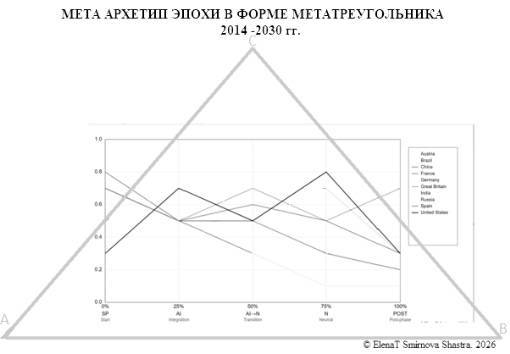
Fig. 1: The MetaArchetype of the Epoch in the form of a supratriangle, which, through its SupraSubject, begins to set a new program for national archetypes starting from 2014. © Elena Smirnova Shastra, 2026.
The diagrams on this page preserve their original Russian labels, as they are part of the author’s primary research materials and reflect the structure of the original analytical model.
The diagrams on this page preserve their original Russian labels, as they are part of the author’s primary research materials and reflect the structure of the original analytical model.
THE NEW WORLD ORDER
NEW METAARCHETYPE OF THE EPOCH (2014 --)
NEW METAARCHETYPE OF THE EPOCH (2014 --)
Excerpt from the book © Elena Smirnova Shastra “The Archetype of Russia”
(scheduled for publication in early 2027)
(scheduled for publication in early 2027)
Thanks to the application of a new scientific method — Transdisciplinary Phenomenology of EthnoArchetypes and Metalinguistic Structures — we were able to reconstruct the archetypes of ten nations based on their ethnonyms and build comparative graphs for analysis (see here).
Through the comparative study of ethnoarchetypes across different cultures, an invariant (unchanging) structure emerges — one that remains stable across transitions between them: differentiation, binding, sequence, contextualization, choice, generalization, and transparency. These features persist across ethnoarchetypes regardless of their cultural content.
This invariant structural matrix, identified through phenomenological comparison of ethnoarchetypes, is what we call the METAARCHETYPE. The MetaArchetype is not a subject and does not possess will or agency; it functions as a structural constant that enables comparison and integration of ethnoarchetypal forms.
Key properties of the MetaArchetype:
• Structurality — composed of functions rather than images.
• Invariance — preserved across cultural transitions.
• Transculturality — independent of specific historical or symbolic contexts.
• Nonsubjectness — does not possess will, direction, or action.
• Metalinguistic nature — serves as a structural foundation for metalinguistic models.
This supranational structure can be represented graphically as a SUPRATRIANGLE (see Fig. 1).Throughout the history of civilization, such metastructures — with their own supratriangles — have always existed.
THE OLD GLOBAL SUPRATRIANGLE OF THE MODERN ERA (≈1780 to 2014)
This was the global structural form of the Modern Era, which began to take shape in the late 18th century, covering the period of the rise of Western science, rationalism, and industrialization. Ontologically, it was a triangle whose vertical axis was connected to the idea of progress understood as a descending program.
Unlike harmonious epochs such as the Renaissance, with its equilateral SupraTriangle, the archetypal triangle of the Modern Era was deformed (see Fig. 2).
The vertical axis of the Modern Era triangle consisted of three layers:
Upper layer — aestheticcultural universalism: humanism, classical aesthetics, the idea of universal culture, the canon of European education. This was the semantic layer that defined the “height” of the triangle.
Middle layer — rationality and science: the scientific method, secularity, progress, technological modernization. This was the operational layer that held the vertical structure together.
Lower layer — industrial density: capital, production, infrastructure, global markets. This was the foundation on which the entire form rested.
Thus, the vertical axis was aestheticcultural → rational → industrial, and not merely rational.
The foundation of the OLD ARCHETYPAL SUPRATRIANGLE OF THE MODERN ERA was connected to technological and economic density.
Its reference points (three nodes) were as follows:
A — the point of accumulation (lower left): economy, industrialization, capital, material density. Geopolitically — the USA/England as the core of accumulation.
B — the point of manifestation (lower right): technology, science, governance, institutions. Geopolitically — Europe as the core of institutional form.
C — the upper point (the apex): associated with Western rational universalism, encouraging the development of human rights, the liberal model, and the idea of progress as a universal program.
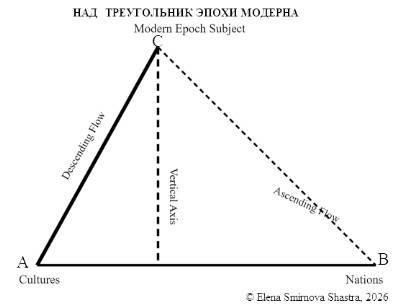
Fig. 2: The Old Triangle (≈1780 to 2014) . The descending flow (A–C) dominated, while the ascending flow (B–C) — the search for meanings coming from people and nations — was suppressed and never formed. © Elena Smirnova Shastra, 2026.
The mission of the OLD SUPRATRIANGLE OF THE MODERN ERA (until 2014) was:
1. Unification of meanings: to create a single global language of rationality.
2. Unification of forms: to standardize economy, science, education, and governance.
3. Unification of subjectness: to reduce subjectness to individual autonomy, and collective subjectness to institutional forms.
4. Maintenance of the global horizontal: to make the world governable through horizontal structures: markets, international organizations, standards.
5. Suppression of ascending flows: to prevent the emergence of alternative verticals of meaning that contradicted the main program of the triangle — such as the search for origins, harmony, or global purpose.
In accordance with the universal law that every form (including triangular forms) has its own subjectcenter, this center:
• receives the descending impulse (program), • maintains the structure of the triangle, • distributes flows, • sets the mission, • ensures coherence.
The Subject of the Old Global Archetypal SupraTriangle of the Modern Era (until 2014)
The subject of the Old Archetypal SupraTriangle of the Modern Era was not a people, not a civilization, and not an epoch. It was the West as a cultural system — not in the geopolitical sense, but in the ontological one: the West as the subject of ModernEra time.
• It maintained the descending flow of meanings that defined the program of civilization’s existence.
• It set the program of progress. • It established universal norms.
• It defined the aesthetic canon.
• It was the source of the scientific paradigm.
• It served as the center of global institutionality.
This was not “the West as countries,” but the West as a cultural vertical.
The descending flow from this subject dominated, while the ascending flow — the search for meanings coming from people and nations — was suppressed.
Why did the action of the Old ModernEra SupraTriangle end in 2014?
Because:
• the descending flow could no longer hold the form — the processes unfolding within individuals and nations were no longer contained;
• the horizontal layer became inert, and active supranational interests began to replace the old global schemes of connection;
• national subjectness began to rise in the form of local conflicts accompanied by slogans of selfdetermination;
• a new vertical of being emerged — “Everything must now be built not as before, but according to universal laws”;
• the Archetype of Russia activated as a vertical stabilizer, expressing its own ideas about national interests within a universal understanding of meaning; • a NEW METAARCHETYPE OF THE EPOCH began to form — a new global structure with its own supraarchitecture.
2014 marks the point where the descending ModernEra SupraTriangle ceased to be stable, and the formation of the ascending MetaArchetype of the Epoch began.
The Transitional Period 2014–2022: The Assembly Phase of the New MetaArchetype of the Epoch.
The completion of the old era of individual national archetypes began in 2014 and concluded by 2022, when a SupraNational MetaArchetype began to form — a new global structure in the shape of the Epochal MetaTriangle.
In the new MetaArchetype of the Epoch, the subjects are not peoples or states, but the meaningnodes of the epoch: technological and informational megastructures, cultural megafields, and archetypal fields of planetary scale.
During the transitional period 2014–2022, three major new archetypal forces of the emerging epoch manifested:
1. The Archetypal Line of FormBreak, when the old form of the world could no longer hold its energy.
2. The Archetypal Line of Return to the Origin, when national subjects began actively seeking deep identity but could no longer find it within their former ethnoarchetypes.
3. The Archetypal Line of FieldEnergy Redistribution, when energy began moving not along the lines of states, but along the lines of meaning.
These three forces of the new MetaArchetype began acting above nations. They do not belong to anyone.
The global triangle during this period reorganizes not around peoples and states, but around these archetypal flows of the epoch — which manifests as the rupture of the old worldform.
The current planetary conflict is the collision between the Old ModernEra SupraTriangle and the emerging MetaArchetype of the Epoch.
It is not “Russia versus someone.” It is not “the West versus someone.” It is not “nations versus nations.”
It is the lines of the new MetaArchetype of the Epoch confronting the old architecture of the world.
Ethnoarchetypes cease to be the primary subjects of evolution; their place is taken by supracivilizational fields of meaning.
STRUCTURAL SIGNS OF THE 2014 RUPTURE (phenomenology)
(Without politics, only structure)
(Without politics, only structure)
1. Breakdown of the previous planetary form (level 1)
• global institutions stopped maintaining universality;
• international mechanisms became less stable;
• the previous architecture of interaction began to fail.
2. Strengthening of the vertical axis of identity (level 2)
• subjects began returning to deep cultural codes;
• the role of historical narratives increased;
• processes of selfdetermination intensified.
3. Weakening of the global horizontal (level 3)
• supply chains became unstable; • global markets lost predictability;
• horizontal structures became less resilient.
4. Growth of meaningfields above states (levels 3–4)
New suprastructures began acting as independent forces:
• information fields and information clusters began operating above political structures;
• technological civilizations and technological nodes became autonomous subjects influencing planetary processes;
• cultural megafields and megaflows became stronger than national institutions.
These phenomena are documented by researchers in media, technology, culture, sociology, and philosophy.
What place do the monolithic United States and Great Britain occupy in the emerging MetaTriangle of the Epoch?
Important: In the old triangle, the United States and Great Britain formed a single horizontal flow, losing differentiation between themselves. This means:
• they are no longer two phases;
• they cannot create binary evolutionary tension;
• they cannot form a vertical axis;
• they cannot serve as the apexes of the new triangle.
In the new MetaTriangle of the Epoch, they do not occupy the apexes. Their place is the unified horizontal plane of the old world.
Morphologically:
• United States = manifestation (expansion)
• Great Britain = accumulation (structure)
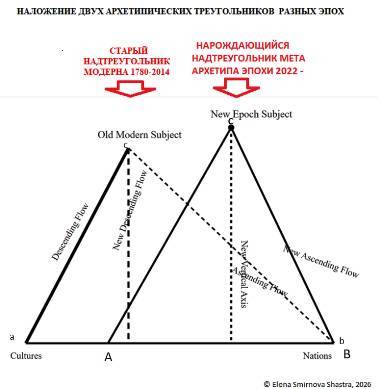
Fig. 3: Map of the overlay between the graphs of the old ModernEra triangle and the new MetaArchetype of the Epoch. Both are still deformed, but the new one is restoring the vertical axis of meaning. In the old triangle, the dashed line b–c — the ascending flow of meanings from people and nations toward the subject — was suppressed and never formed into a stable vertical. In the new triangle, the solid (potentialbased) line B–C is not yet complete — it is in the process of formation. The extension of the B–C line indicates the tension between the ascending impulse and the stillunformed vertical axis.
© Elena Smirnova Shastra, 2026
But in their combined state, they become the horizontal layer of the old order, unable to transition. In the NEW METATRIANGLE OF THE EPOCH, they function as stabilizers of the old plane, which: • preserves previous norms, • resists vertical transition, • prevents synthesis, • prevents the emergence of a new vertical axis.
They become the background, not the apexes.
The United States and Great Britain, having lost their role as apexes in the new MetaTriangle of the Epoch, retain the function of keepers of universal horizontal instruments of civilization. These instruments — language, the scientific method, procedurality, technological infrastructure, and the culture of open knowledge — do not belong to the old order; they belong to civilizational universality itself.
Therefore, the NEW METATRIANGLE OF THE EPOCH will accept, integrate, and reinterpret them within the new vertical axis of meaning.
English as the primary universal gift. It is accepted by the new epoch because English has become: • a universal mediator of meanings, • the metalinguistic medium of global communication, • a neutral channel of exchange, • an instrument of horizontal connectivity, • independent of the subjectness of the old order.
It does not carry the vertical axis of the old world — it carries instrumentality.
Therefore, English will remain the global working language of the New Epoch, but will cease to be a carrier of the old subjectness.
The new epoch will not accept conflict as a structural tool for maintaining order
Elements of the old order associated with hegemony, expansionism, ideological universalism, financialspeculative dominance, monopolistic control over global infrastructures, reduction of the subject to consumer identity, and normalization of conflict as a management tool will not be accepted by the New Epoch.
These components belonged to the architecture of the old horizontal and relied on the asymmetry of the descending flow, whereas the NEW METATRIANGLE requires:
• a centered vertical axis, • balance of flows, • rejection of any form of unipolar subjectness.
THE EMERGING NEW METATRIANGLE OF THE PLANETARY EPOCH
IS FORMING A NEW WORLD ORDER
IS FORMING A NEW WORLD ORDER
The NEW METAARCHETYPE OF THE EPOCH has the form of a TRIANGLE with the following archetypal structure (see Fig. 1).
1. The Horizontal Axis of the MetaTriangle — Planetary Forms. These are points A and B of the MetaTriangle.
1. The Horizontal Axis of the MetaTriangle — Planetary Forms. These are points A and B of the MetaTriangle.
The horizontal axis at the metalevel is not composed of states or peoples, but of processes that operate above them. These are planetary forms that do not belong to any single nation. In other words, the horizontal axis of the metalevel consists not of countries, but of processes: transnational energy nodes (not organizations, but processes), archetypal nodes of the epoch.
Participants of the MetaTriangle of the Epoch: Technological nodes as metasubjects (NOT companies).
Technological civilizations: global technological networks, technological nodes, digital ecosystems; global technological hubs; infrastructures not belonging to any single ethnos.
Examples (as phenomena, not institutions): • global cloud infrastructure, • global AIenergy (concentration of computational power), • global logistics networks as continuous processes, • global digital identity as a universal form, • global automation as a civilizational phenomenon.
Cultural megaflows as metasubjects (NOT industries).
Cultural megafields, transnational cultural centers, global cultural flows. These are not Netflix, not Bollywood, not KPop — but cultural fields without ethnic form.
Examples: • the flow of short formats (clipthinking), • the flow of memetic culture, • the flow of serialized life (narrative culture), • the flow of visual identity (selfconstruction through image), • the flow of global musical hybridization.
Technological civilizations as metasubjects (NOT countries).
These are not China, not the USA, not Russia — but civilizational processes without ethnic form.
Examples: • the civilization of algorithms, • the civilization of data, • the civilization of automation, • the civilization of distributed networks, • the civilization of digital ecosystems.
Information clusters as metasubjects (NOT platforms).
Information fields, information clusters, media flows, network structures, meaningclusters. These are not Meta, not Telegram, not WeChat — but information fields acting above platforms.
Examples: • the cluster of instant communication, • the cluster of open knowledge, • the cluster of meaningturbulence, • the cluster of digital memory, • the cluster of global selfcommunication.
Cultural megafields as metasubjects (NOT cities).
Meaningnodes of the epoch: new centers of meaningassembly; new forms of collective identity; meaningcenters.
These are not Seoul, not Tokyo, not Paris — but cultural fields without geography.
Examples: • the megafield of virtual culture (VR/AR), • the megafield of gameculture (gamethinking), • the megafield of digital mythology, • the megafield of instant fashion, • the megafield of global visual culture.
2. The Upper Point of the MetaTriangle (meaning, program, light)
Point C of the MetaTriangle of the Epoch has two manifestations:
• Descending function: the metaimpulse of the epoch descends as a form of time, a global program.
• Ascending function: epochal flows lift cultural and technological light toward the metameaning.
Descending function — when the epoch “issues a command from above”. This resembles the emergence of a new “fashion of time,” which everyone must adapt to.
Examples:
1. The Industrial Era “descended” the idea of factories, machines, mass production — and the world reorganized.
2. The Digital Era “descended” the internet and smartphones — and all countries began living in a digital world.
3. The New Epoch “descends” the idea of meaning and connectedness — and the world begins seeking depth and awareness, not just technology.
Ascending function — when humanity lifts its achievements upward. This resembles humanity bringing its best ideas “to the center of the epoch.”
Examples:
1. Renaissance artists lifted art and science — and the epoch became humanistic.
2. Scientists of the 20th century lifted physics, space, biology — and the epoch became scientifictechnological.
3. Today humanity lifts AI, culture, and new meanings — and the epoch becomes metameaningful.
3. The Side Lines of the MetaTriangle (movement, transformation)
Lines A–C and B–C. The side lines of the MetaTriangle perform two functions:
• Descending: distributing the metaimpulse of time and space across the global horizontal.
• Ascending: lifting cultural and technological flows toward metameaning.
Their interaction forms the architecture of the epoch and its vertical axis of meaning.
These two tendencies always coexist, like: • inhale ↔ exhale, • descent ↔ ascent, • formation ↔ development.
Descending function — when the epoch “sets the rules of the game”.
Examples: • The Industrial Era “descended” factories and mass production — and the world lived by factory rules. • The Digital Era “descended” the internet and smartphones — and everyone began living in a digital world. • The New Epoch “descends” meaning and connectedness — and the world begins seeking depth rather than mere technology.
Ascending function — when humanity lifts its achievements upward.
Examples: • Renaissance artists lifted art and science — and the epoch became humanistic. • 20thcentury scientists lifted space and physics — and the epoch became scientific. • Today humanity lifts AI, culture, and new meanings — and the epoch becomes metameaningful.
The Vertical Axis of the MetaTriangle (light, connectedness, pressure)
It is dual and consists of two flows:
• Descending vertical: the metaimpulse of the Epoch forms the global structure. • Ascending vertical: epochal flows rise toward metameaning.
Detailed description of the levels of the Vertical Axis
Level 1 (lower) — FormBreak.
• the old worldform stops holding energy; • previous institutions lose universality; • the horizontal of the ethnolevel becomes unstable. Function: completion of the old world architecture.
Level 2 — Identity ReWiring.
• subjects search for new foundations of identity; • the role of cultural codes intensifies; • a crisis of belonging emerges. Function: restructuring of the meaningvertical.
Level 3 — Redistribution of FieldEnergy.
• energy moves along lines of processes, not states; • technological nodes become centers of force; • information fields act above political structures. Function: change of energy carriers.
Level 4 — Assembly of New Centers.
• new meaningnodes appear; • new cultural megafields form; • new technological civilizations emerge. Function: creation of a new world architecture.
Level 5 — Field Alignment.
• new centers begin interacting; • new coherence emerges; • new rules form. Function: stabilization of the transition.
Level 6 — The New Vertical of the Epoch.
• a new meaningframework appears; • a new planetary identity forms; • a new axis of the epoch emerges. Function: formation of new meaning.
Level 7 (upper) — MetaMeaning.
• the epoch receives its purpose; • the planetary field organizes around a new meaning; • a new evolutionary line emerges. Function: setting the direction of the next epoch.
Normative crises
Normative crises may arise as tensionnodes, which are inevitable for any binary system. The MetaTriangle of the Epoch must balance the dynamics of forces so that:
• the descending metaimpulse of the Epoch does not become excessive and cause global pressure, • and the ascending flows do not become chaotic, preserving connectedness.
SUBJECTNESS OF THE METAARCHETYPE
An epoch must have its own subjectcenter; otherwise, it is not a form. (Clarification: here, subject refers to the entity (animate or inanimate) to which an action, property, or relation pertains. This understanding goes back to the ancient philosophical concept ὑποκείμενον (hypokeimenon), Latin subiectum — “that which lies at the foundation.” There are notable cultural differences between Russian and English interpretations of the term subject.)
The SupraSubject. The SupraSubject is a superstructural level of subjectness that stands above individual and national subjectforms. It is the carrier of volitional, directional, and meaningforming functions that ensure the coordination and maintenance of large civilizational processes. The SupraSubject is not a structural invariant; it belongs to the vertical model of subjectness and acts through the structural matrices available to it, including the MetaArchetype, but is not identical to them.
Key properties of the SupraSubject:
• Subjectness — possesses will, direction, and choice. • Superstructural nature — stands above national subjects. • Meaningformation — shapes the direction of the epoch, large cycles, and civilizational vectors. • Action through structure — uses invariant matrices (including the MetaArchetype) as forms of manifestation. • Noninvariance — is not a structural intersection; belongs to the vertical axis of subjectness.
Why the subject of an epoch cannot be a person, a nation, or a culture
Because:
• a person is too small in scale, • a nation is a partial form, • culture is a horizontal structure, • civilization is also a form, but not a subject.
Therefore, the subject of an epoch must stand above all these levels. This is not “a hidden force behind the scenes” and not “a conspiracy.” The SupraSubject of the Epoch = the metaagent of the epoch.
It is not a “person,” not a “spirit of the time,” not a “civilization.” It is a structural center that performs the same functions that a monad performs for a person or a nation.
Functions of the SupraSubject of the Epoch
• receives the descending impulse from the Source; • unfolds it into the program of the epoch; • forms the vertical axis of time; • organizes the flows of space; • sets the mission of the epoch; • maintains the coherence of all forms within the epoch; • serves as the upper point of the MetaTriangle; • possesses dual connectedness.
Thus, the SupraSubject of the Epoch is its “who.”
Why it is a suprasubject
Because it stands above:
• the subjects of nations, • the subjects of civilizations, • the subjects of cultures, • the subjects of social forms.
It is the subject of the level of time, not the level of matter.
The MetaArchetype of the Epoch as a meaningentity
The MetaArchetype of the Epoch possesses the being of meaningwholeness — a type of being for which modern humanity has not yet developed a name, because it is not phenomenologically familiar with it. It is a potential unified state of humanity — a single and coherent consciousness of humanity, in which individual units of consciousness retain their spark but function as a collective whole.
This phenomenon is expected to begin manifesting precisely in our time. Attempts to describe it were made by philosophers of Russian cosmism, but it remains almost unknown in Western thought.
Only such a collective subject of humanity is capable of:
• producing and transmitting the meaning of the new epoch, • setting and initiating directions and processes, • restructuring forms of existence, • forming normative crises for subsequent evolutionary steps, • completing old structures and opening new ones.
Formula
SupraSubject of the Epoch = subject of time, receiving the descending impulse from the Source and forming the program of the epoch.
The geometric place of the subject in the triangle.
Every form has a strictly defined geometric location for its subject. This can be determined precisely, without metaphors, in strict structural logic.
I. Universal law
The subject is the point where:
• the descending impulse of the Source enters the form, and • the ascending impulse of the form returns to the Source.
It is the node of two tendencies.
Therefore, it can only be located on the vertical axis, because the vertical is the axis of:
• meaning, • light, • mission, • connectedness, • pressure, • evolution.
II. Geometric location of the subject in the triangle
The subject is the node on the vertical axis between the upper point and the center of the horizontal. This is the only place where:
• the descending impulse has already entered the form, • the ascending impulse has already risen from the form, • both impulses meet, • connectedness emerges, • mission is formed, • structure is maintained, • the subjectform arises (in our case — the SupraSubject of the Epoch).
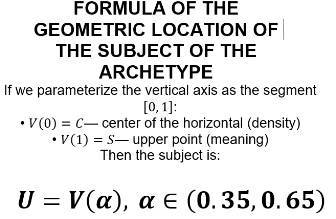
Clarification: the coordinates of the SupraSubject.
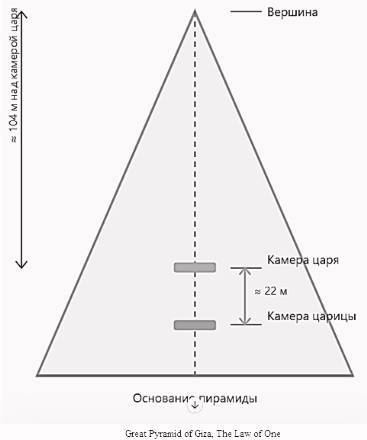
The geometric position of the SupraSubject of the Epoch is analogous to the location of the “Queen’s Chamber” in the Great Pyramid. If we consider the pyramid as a threedimensional continuation of the triangle:
• the King’s Chamber corresponds to the upper point — meaning, program, impulse; • the Queen’s Chamber lies in the middle zone of the vertical axis, between the base and the apex — in the same range α ≈ 0.35–0.65 where we define the subject of the form; • the base corresponds to density, root, binarity.
Thus, the Queen’s Chamber is the spatial analogue of point U, the node of equilibrium between descending and ascending flows, where the energy of the form transitions from density to meaning.
In the pyramid, the subject maintains not only synthesis but also hierarchy of levels; it governs the distribution of energy across the volume, not only along the vertical. Ontologically, the pyramid is a form of being in which the suprasubject holds the world.
In our case — the MetaTriangle of the Epoch — the SupraSubject holds the formation of the form and its meaning.
THE ROLE OF RUSSIA IN THE EMERGING METATRIANGLE OF THE EPOCH
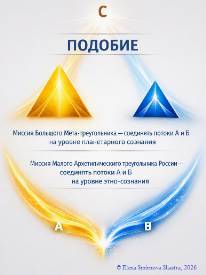
If the MetaArchetype of the Epoch (the large metatriangle) is a universal structure, and the ethnoarchetype of Russia (the small ethnotriangle) is its local, cultural, and historical version, then their relationship can be described as scalesimilarity of meaningform.
That is: • the form is preserved, • the content is scaled, • the context changes, • the structure remains.
When one triangle is a scaled copy of another — when angles, proportions, and form are preserved while scale changes — this is called similarity. It is a fundamental geometric operation.
Here, similarity appears as a phenomenological operator. In phenomenology, similarity means:
• preservation of structure under changes in experiential scale, • invariance of meaningform, • scalability of the archetype, • transition from individual to collective without loss of morphology.
This corresponds to what Heidegger called Gestalt, Jung called archetypal form, and what we describe as morphodynamics of the meaningfield.
When the planetary vertical of the MetaArchetype strengthens It exerts pressure on all countries simultaneously — but each responds differently.
The Russian vertical is a distinct phenomenon: • a vertical of light, • a vertical of differentiation, • a vertical of meaningholding, • a vertical of national subjectness, • a vertical of transition between phases of the planetary field.
It is not:
• a political force, • a cultural expansion, • an ideology, • an influence on other countries.
It is a morphological element of the planetary field.
During 2014–2022 the Archetype of Russia activated as a vertical stabilizer
But in subsequent years its role changes:
1. The Archetype of Russia ceases to be a vertical only for its ethnolevel and becomes one of the vertical nodes of the metalevel across the planet.
2. It begins to function as a deep stabilizer, holding the axis of connection with the Source and the program of the epoch, while new forces (FormBreak, Identity ReWiring, FieldEnergy Redistribution, Assembly of New Centers) create turbulence.
3. It begins to act as a meaningcore, a carrier of depth rather than a carrier of form.
4. It begins to function as a transitional archetype, helping the planetary field shift from the old architecture to the new one, because its archetypal nature is to hold the axis during epochal transitions. This is not a political role — it is an archetypal function in the model.
The Russian vertical influences unipolar countries (such as the USA–Great Britain) not directly. Russia does not “influence” other countries socially or politically. But it influences morphologically. When the Russian vertical enters its internal phase of rupture (a normative crisis of restructuring):
• the planetary horizontal ceases to be monolithic — it cracks, • unipolar archetypes lose their previous stability and support, • their own verticals begin “searching for a new form,” • their internal verticals are forced to restructure.
This happens because the Russian vertical is one of the supports of the planetary field. When it changes phase, the planetary structure changes.
For unipolar countries, the “vertical requiring a new form” is not Russia. It is their own vertical, which no longer aligns with the previous planetary horizontal.
But the cause of restructuring is the change in the planetary field — in which the Russian vertical plays a key role.
This is not destruction — it is a morphological transition. Systems “fall apart” not because they are weak, but because the vertical demands a new form.
The Russian vertical is the transitionpoint between planetary phases. It: • holds meaning, • initiates rupture, • launches transition, • creates a new phase.
Therefore its state affects: • the USA, • Europe, • Asia, • global structures. Not politically. Not socially. But morphologically.
The Archetype of Russia carries a unique feature: beingness. It carries beingness (as eternal, nontransient values) embedded in the vertical of its cultural code.
This beingness:
• is accessible to a person at the personal level, • is experienced as depth and meaning, • provides inner support, • allows one to hold the vertical in crisis, • forms sobornost as collective being.
IMPORTANT: The New MetaArchetype of the Epoch will have the same nature of beingness as the Archetype of Russia. But: • not tied to a people, • not tied to a territory, • not tied to a culture. It will become the planetary subject producing the meaning of the epoch.
SIMILARITY BETWEEN THE SUBJECTNESS OF THE METATRIANGLE AND RUSSIAN NATIONAL SUBJECTNESS
In the emerging MetaTriangle of the Epoch, the SupraSubject has not yet revealed its mission or mechanism of existence. But it has a model — the national ethnoarchetypal subject of Russia, well described by the authors of Russian cosmism.
This phenomenon is sobornost.
1. The suprasubjectness of the MetaArchetype resembles Russian subjectness in the archetypal sense
In any universal form, the subject is a binary living system of connectedness between:
• the descending transcendent channel receiving the impulse of meaning, and • the ascending immanent channel producing action, knowledge, form.
The Russian variant — sobornost — appears as a distributed cognitive system in which individual consciousnesses form a supraindividual subject with new qualities not reducible to the average of the collective. Such a higherlevel formation can influence the surrounding world. This phenomenon was described by Russian cosmists: Khomyakov, Florensky, Solovyov, Trubetskoy, Lossky, Khoruzhiy, Fyodorov, and by Vernadsky’s studies of noospheric consciousness.
• Sobornost — the principle of organizing a multiplicity of consciousnesses.
• Sobornoye consciousness — the emergent quality of this unity.
• Noosphere — the historicalplanetary reality created by this unified humanity.
• The Common Task — the conscious activity through which humanity becomes such a subject.
In this sense, the Russian subject, as the archetype of sobornaya form, serves as a model for Western culture, where subjectness is still often understood as individual autonomy rather than a field of collective thinking — and where the term sobornost is virtually unknown.
Only a few contemporary authors approach the idea of unified human consciousness — such as Gilbert Simondon (transindividuality), Hutchins (distributed cognition), Mead (the social formation of the self), Peirce (communityformed knowledge), Durkheim (collective consciousness), all drawing on Hegel’s Geist.
For the Russian ethnotriangle, sobornost is the systemforming feature of the form. It is analogous to the subjectpart of the emerging MetaTriangle of the Epoch. But in the latter, this phenomenon is only beginning to emerge as an attempt to understand unified consciousness at the scale of humanity.
The Russian subject is the archetype of sobornaya form, while the Western subject is still only its projection in the individual dimension.
Subject — the binary node where descending meaning becomes ascending action
In Russia this node is realized as sobornost — a collective form of consciousness. At the epochal scale — as the future metasobornost of humanity.
DIFFERENCE BETWEEN THE TWO TRIANGLES: THE NATIONAL RUSSIAN ETHNOTRIANGLE AND THE EMERGING PLANETARY METAARCHETYPE TRIANGLE
Space and time are inseparable — a single continuum. But subjectness manifests differently within them.
In ontology, they perform different functions, and function determines the type of subject.
Subject of the Epoch = subject of time.
Subject of the Nation = subject of space.
Not because time and space are “different,” but because their roles in formcreation differ.
Epoch = form of time. • determines direction, • sets the vector of the descending impulse, • forms the program, • organizes sequence.
Therefore its subject is the subject of time.
Nation = form of space • holds density, • forms the cultural body, • organizes distribution, • creates material and social forms.
Therefore its subject is the subject of space.This does not contradict the unity of spacetime, because subjectness is not physics — it is ontology (lived experience).
In ontology: • time = direction of meaning, • space = unfolding of form.
Two sides of one process — but: Meaning descends through time. Form ascends through space.
Therefore:
• the subject of the epoch works with the descending transcendent flow (B↓), • the subject of the nation works with the ascending immanent flow (R↑).
If we mixed the subject of time and the subject of space, the structure of the triangle would collapse
But every subject is dual in function — as everything in the universe.
The subject of time and the subject of space meet in the node where descending and ascending flows converge, forming the point where meaning ignites.
In our case, this node is generated by the triad: EPOCH → NATION → PERSON.
All subjectness in the universe is binary • subject of time — receives the descending impulse (B↓), • subject of space — produces the ascending impulse (R↑).
Two sides of one mechanism: Time gives the program. Space gives the form.
What happens at this point? • time ceases to be pure meaning, • space ceases to be pure density, • both become connectedness, • and the subject of form is born.
This is the only place where: • meaning becomes action, • program becomes form, • time becomes space, • space becomes time.
The binary nature of time and space produces three types of subjects, Because each type is a distinct way of combining flows.
I. Subject of the Epoch (suprasubject of time)
It operates under the dominance of the descending flow: • receives the impulse from the Source, • forms the program of the epoch, • sets the direction of time.
This is the subject of time, because its function is the ordering of meaning.
II. The Subject of the Russian Nation (subject of space)
It operates under the dominance of the ascending flow:
• receives the program of the epoch, • unfolds it into cultural form, • creates density, body, language, tradition.
This is the subject of space, because its function is the unfolding of form.
III. The Subject of the Human Being (individual subject)
It operates in the equilibrium of flows:
• receives the cultural descending flow, • produces the individual ascending flow, • unites meaning and action in personal form.
This is the subject of form, because it is the miniature node of the light of meaning — the human subject seeks and creates equilibrium.
Three subjects = three modes of connecting time and space.
|
About the author
ElenaT Smirnova Shastra
- PhD psychologist.
- The author of over 50 scientific publications in psychology and 19 monographs.
- Member of The Institute of Planetary Synthesis (IPS) at the UN, (Мember of the Board of Advisors IPS).

- Member of The Society for Existential Analysis (United Kingdom):
- Member of The Russian League of professional psychotherapists (PPL) National Awarding Organisation (NAO) for the European Certificate of Psychotherapy.
- Member of the International Federation of Journalists (IFJ) and the Russian Union of Journalists.
- Member of The Noosphere Spiritual Ecological World Assambly.
Lives and works in New Zealand.
Signed the Manifesto for a Post-Materialist Science
Вебсайт http://esoterictour.co.nz/
|
|||||
|
Short Summary
|
|||||
|
Under new conditions, the Russian ethnoarchetype is the seed of the future epoch. It creates a new point of civilizational synthesis.
• Old epoch: three points of synthesis → turned into a plane → lost the vertical. • New epoch: one vertical (Russia) → holds two universal horizontals (depth and form). • Geography is not important: types of civilizations are. • Russia connects the entire plane of the epoch. Real scale: Russia holds all contradictions of the epoch. Russia is not “a bridge between two countries.” Russia is the vertical synthesizer of all horizontal tensions of the epoch, including: External contradictions: • civilization of depth ↔ civilization of form • continental models ↔ oceanic models • collective archetypes ↔ individual archetypes • traditional cultures ↔ technocultures • southern civilizations ↔ northern civilizations • East ↔ West (as a derivative, not a primary structure) Internal contradictions: • ethnocultural layers • civilizational strata within Russia itself • internal archetypes of subjectness • internal lines of rupture and integration • internal flows of depth and form • internal crises of meaning and identity Thus, Russia is the vertical axis of the entire plane of the epoch. |
|||||
|
Keywords
Elena T. Smirnova (Shastra). Intellectual anthropology, phenomenology, metalinguistic system, new scientific method for studying archetypes, Archetype of Russia, new world order, new Planetary MetaTriangle of the Epoch, the role of Russia on the planet, old supratriangle of the Modern Era (≈1780–2014). |
|||||
|
Literary Sources
1. A.A. Bailey. The Destiny of the Nations. Ch.2, paragraph 61. Lucis Publishing Company, 1949.
2. A.A. Bailey. The Destiny of the Nations. Ch.5, paragraph 101. Lucis Publishing Company, 1949.
3. Thomas Röper. “Putins Plan – ‘Mit Europa und den USA endet die Welt nicht.’ – Wie das westliche System sich gerade selbst zerstört und was Russland wirklich will”. J.K. Fischer Verlag, Gelnhausen, Germany, 2022.
New Zealand
2026
End of the introductory fragment.
|
|||||
|
The text uses terms of the metalinguistic system.
|
|||||
Copyright © ESOTERICTOUR 2010-26 Любое использование информации сайта допускается только с прямой ссылкой на автора сайта Елену Смирнову и на сайт http://esoterictour.co.nz
В оформлении сайта используются природные паттерны: дно океана, игра солнца в воде, радуга, причудливые формирования лавы, съемки ночного неба Южного Полушария и др., что способствует гармонизации состояния психики.Условия использования изображений сайта