






Who is
the World Teacher ?He - One, but He has many names:
the World Teacher ?He - One, but He has many names:
We often hear the terms: Higher Self, Soul, Spirit, Divine Spark, Self, Self-Image, and other expressions that point to a deep true core which simultaneously belongs both to us and to the Source of life. Can this core be explored? Every person understands that the only way to investigate this question is through lived experience. A human being has no other means of knowing.
The one who experiences is called the subject. Who is this? What do ancient traditions of philosophy, culture, and religion say about it?
TRADITIONS ABOUT THE SUBJECT AS THE DEEP TRUE CORE OF THE HUMAN BEING
The subject in all ancient traditions of thought is always the same.
However, it manifests and is named differently depending on the level of identification—WHERE it is experienced—and depending on its function—HOW it is experienced. Let us try to answer the question: WHO is the subject in different traditions. Specifically “WHO,” not “what does it do?”
The one who experiences is called the subject. Who is this? What do ancient traditions of philosophy, culture, and religion say about it?
TRADITIONS ABOUT THE SUBJECT AS THE DEEP TRUE CORE OF THE HUMAN BEING
The subject in all ancient traditions of thought is always the same.
However, it manifests and is named differently depending on the level of identification—WHERE it is experienced—and depending on its function—HOW it is experienced. Let us try to answer the question: WHO is the subject in different traditions. Specifically “WHO,” not “what does it do?”
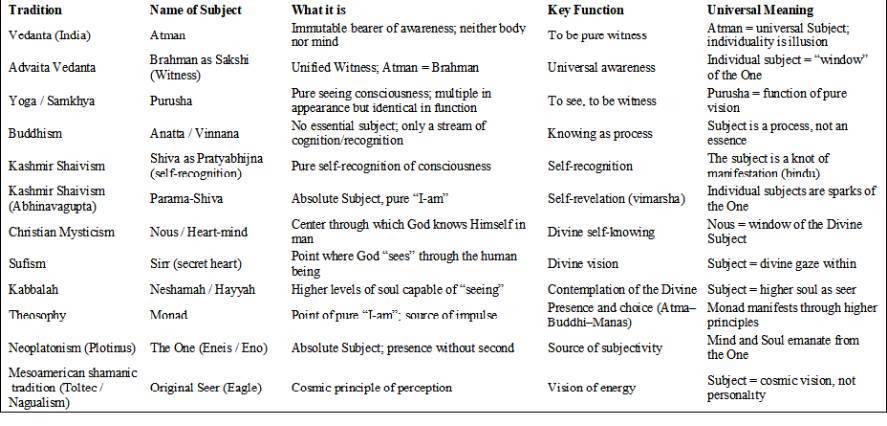
TABLE 1. THE SUBJECT IN DIFFERENT TRADITIONS OF PHILOSOPHICAL, RELIGIOUS, AND CULTURAL THOUGHT. (Universal structure, one principle, but different languages)
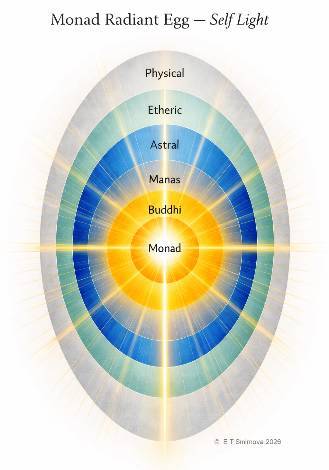
© E T Smirnova 2026. Monad Egg
In this study, we will adhere to the fundamental idea shared by all cultural, philosophical, and religious traditions of all civilizations: that the One Subject is the Source of life, which manifests itself on different levels of reality—the so-called cosmic planes. Most traditions uphold the idea of the identity of the ONE and CONSCIOUSNESS. Since the human being also exists on these planes, the One Subject manifests in the human being as an individual subject (what we often call “I”).
THE SUBJECTIVITY NODE IS A LOCAL POINT IN WHICH THE ONE SUBJECT MANIFESTS ITSELF AS “I” IN A GIVEN BEING WITHIN INDIVIDUAL EXPERIENCE.
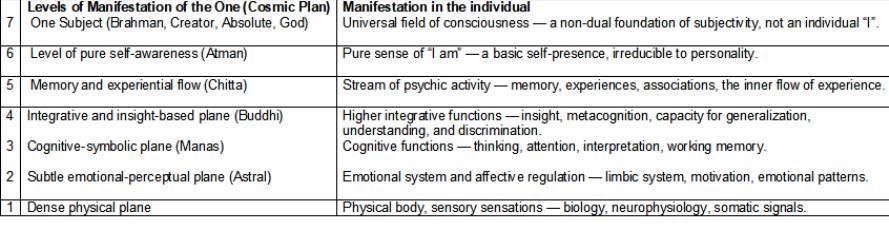
TABLE 2. THE MANIFESTATION OF THE ONE SUBJECT IN THE INDIVIDUAL ACROSS DIFFERENT COSMIC PLANES (in brackets are commonly used terms from Eastern traditions).
We have answered the question: WHO is the Subject who experiences?
Now it is important to understand what happens to the Subject at different levels of its manifestation in matter?
Answer: at each level, it forms a “NODE,” a point of fixation.
THE SUBJECTIVITY NODE: WHERE IS THE SUBJECT FIXED?
The node is a point of fixation of the Subject.
Now it is important to understand what happens to the Subject at different levels of its manifestation in matter?
Answer: at each level, it forms a “NODE,” a point of fixation.
THE SUBJECTIVITY NODE: WHERE IS THE SUBJECT FIXED?
The node is a point of fixation of the Subject.
The node ≠ the Subject. The Subjectivity Node is a “place” where consciousness becomes self-aware, where the sense of “I am” arises as a pure fact, not as a personality. It is not a form, not psyche, not history, not qualities, but the self-recognition of presence—the “place” where the Light of Consciousness recognizes itself as connected to the Source.
The term “Subjectivity Node” is precise; it points to a “coalescence” of light through which the consciousness of the Subject is manifested. However, in Western language the term may sound like a constriction or spasm rather than liberation (thus the semantics contradict the function). Nevertheless, some traditional terms such as “Divine Spark” (Gnosticism) or “Assemblage Point” (C. Castaneda) loosely point to a similar structure of consciousness as an element of form.
In the model considered here, the “Subjectivity Node” is: a point of assembly, a place of recognition, a vertical center of the Subject, a possibility for the expansion of Light through “untying” the Node (and the beginning of liberation).
The term “Subjectivity Node” is precise; it points to a “coalescence” of light through which the consciousness of the Subject is manifested. However, in Western language the term may sound like a constriction or spasm rather than liberation (thus the semantics contradict the function). Nevertheless, some traditional terms such as “Divine Spark” (Gnosticism) or “Assemblage Point” (C. Castaneda) loosely point to a similar structure of consciousness as an element of form.
In the model considered here, the “Subjectivity Node” is: a point of assembly, a place of recognition, a vertical center of the Subject, a possibility for the expansion of Light through “untying” the Node (and the beginning of liberation).
The Subjectivity Node is a local point in which the One Subject manifests itself as “I” in a given being within individual experience.
The Subject is always one, although it has different names in different traditions (Ātman / Puruṣa / Śiva / Nous / the Universal One). Nodes are many (bindu, buddhi, heart, sushumna center, dantian, etc.). Nodes allow the Subject to function in different ways: through observation, witnessing, recognition, and so on.
Thus, in the traditions described, although the word “node” is usually not used, the meaning points to WHERE the same single Subject manifests itself. This conditional “location of fixation of conscious Subjectivity” is structured into a vertical hierarchy, traditionally in a seven-stage system.
TABLE 3. HOW THE SUBJECT RELATES TO THE NODE AT DIFFERENT LEVELS AND IN DIFFERENT TRADITIONS
The Subject is always one, although it has different names in different traditions (Ātman / Puruṣa / Śiva / Nous / the Universal One). Nodes are many (bindu, buddhi, heart, sushumna center, dantian, etc.). Nodes allow the Subject to function in different ways: through observation, witnessing, recognition, and so on.
Thus, in the traditions described, although the word “node” is usually not used, the meaning points to WHERE the same single Subject manifests itself. This conditional “location of fixation of conscious Subjectivity” is structured into a vertical hierarchy, traditionally in a seven-stage system.
TABLE 3. HOW THE SUBJECT RELATES TO THE NODE AT DIFFERENT LEVELS AND IN DIFFERENT TRADITIONS
Nodes of Fixation (Centers, Foci) at Each Level of Being
At different levels of existence, nodes (centers of fixation, foci) are experienced and perceived differently.
Across different levels of node fixation, the functions, modes, and regimes of reflection and experience change.
The Subjectivity Node is a point of ownership of experience, the minimal form of “I-am-ness,” which can reside at different levels of the vertical hierarchy. It is not fixed; it migrates.
At different levels of existence, nodes (centers of fixation, foci) are experienced and perceived differently.
Across different levels of node fixation, the functions, modes, and regimes of reflection and experience change.
The Subjectivity Node is a point of ownership of experience, the minimal form of “I-am-ness,” which can reside at different levels of the vertical hierarchy. It is not fixed; it migrates.
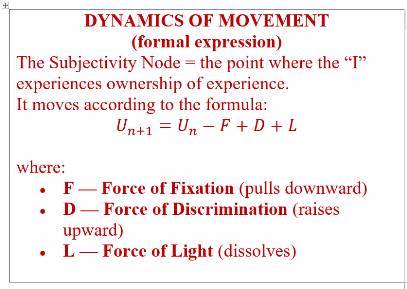
HOW DOES THE NODE MOVE?
The Subjectivity Node does not move according to the will of the mind, but through three forces:
1. The Force of Fixation
Pulls downward: body → emotions → practical mind.
This is what horizontal mental activity (analysis, comparison, differentiation) does to objects of experience, through filters and interpretative constraints.
It creates fragmentation and limits perception through conceptual division.
2. The Force of Discrimination
This is the ascending movement of consciousness along the vertical vector of reality.
It lifts upward and moves beyond fragmenting analysis, allowing one to perceive the structure and essence of phenomena as a whole in the light (Ātman) coming from a higher level:
mind (manas) → intuitive discrimination (buddhi) → consciousness (ātman).
3. The Force of Light
This force dissolves the node into the One.
It represents the level of the human being as a focal point for the registration of Idea.
Ātman → Light.
The Subjectivity Node does not move according to the will of the mind, but through three forces:
1. The Force of Fixation
Pulls downward: body → emotions → practical mind.
This is what horizontal mental activity (analysis, comparison, differentiation) does to objects of experience, through filters and interpretative constraints.
It creates fragmentation and limits perception through conceptual division.
2. The Force of Discrimination
This is the ascending movement of consciousness along the vertical vector of reality.
It lifts upward and moves beyond fragmenting analysis, allowing one to perceive the structure and essence of phenomena as a whole in the light (Ātman) coming from a higher level:
mind (manas) → intuitive discrimination (buddhi) → consciousness (ātman).
3. The Force of Light
This force dissolves the node into the One.
It represents the level of the human being as a focal point for the registration of Idea.
Ātman → Light.
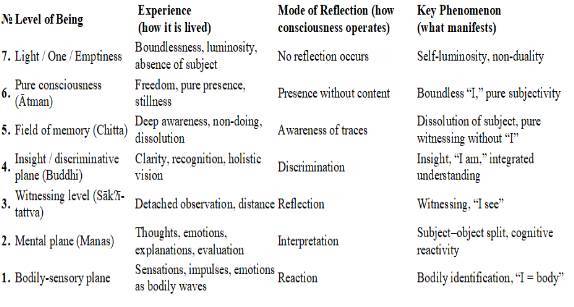
FUNCTIONS, MODES, AND REGIMES OF REFLECTION AND EXPERIENCE OF THE SUBJECT
Traditional terms (manas, buddhi, ātman, sākṣitattva) are used in brackets as technical designations, since they allow for a precise distinction between levels of consciousness functioning for which modern secular terminology has no unambiguous equivalents. The primary terminology remains secular.
These terms originate from classical Indian philosophical traditions, primarily:
These terms originate from classical Indian philosophical traditions, primarily:
Sāṅkhya
Yoga (Patañjali)
Advaita Vedānta
Kashmir Shaivism (Pratyabhijñā)
It is within these traditions that the most precise and detailed model of the structure of consciousness was developed, including:
Manas — mind, emotions, reactions
Buddhi — discrimination, clarity
Ātman — pure consciousness
Sākṣitattva — witnessing principle
In contemporary secular terminology, there are no exact equivalents that allow such a precise differentiation of levels of consciousness functioning. Therefore:
traditional terms are used only in brackets as technical markers,
while the primary terminology remains secular and scientific.
This creates a dual coordinate system:
traditional terms are used only in brackets as technical markers,
while the primary terminology remains secular and scientific.
Structure refers to WHERE the Subjectivity Node is fixed.
Function refers to HOW the One Source is reflected by the Subject.
None of the modes (Observer / Witness / “I Am”) is the “who.” These are modes of reflection that arise when the Subjectivity Node is fixed at a specific level.
But the question remains: how does the Subjectivity Node experience itself while moving across the seven levels of being?
It is precisely this that should include the function of reflection.
Function refers to HOW the One Source is reflected by the Subject.
None of the modes (Observer / Witness / “I Am”) is the “who.” These are modes of reflection that arise when the Subjectivity Node is fixed at a specific level.
But the question remains: how does the Subjectivity Node experience itself while moving across the seven levels of being?
It is precisely this that should include the function of reflection.
TABLE 7. SEVEN-LEVEL MODEL OF THE VERTICAL STRUCTURE OF SUBJECTIVITY NODES ACROSS LEVELS OF BEING WITH FUNCTIONS
TABLE 8. HUMAN EXPERIENCE OF LEVELS OF CONSCIOUSNESS (PHENOMENOLOGY)
Why does a human being use the concept of “I”? What do they actually put into this word?
How do traditions distinguish the true Self from the inauthentic one — from roles and masks?
Each tradition describes levels of the individual subject — from true self-awareness to false identifications. We can trace a downward path along the vertical axis: how the True Subject (which has no “I”) “clothes itself” in different planes and becomes an “I” → false self → masks.
DESCENT OF THE “I” THROUGH LEVELS OF REALITY
How do traditions distinguish the true Self from the inauthentic one — from roles and masks?
Each tradition describes levels of the individual subject — from true self-awareness to false identifications. We can trace a downward path along the vertical axis: how the True Subject (which has no “I”) “clothes itself” in different planes and becomes an “I” → false self → masks.
DESCENT OF THE “I” THROUGH LEVELS OF REALITY
The True Subject, in its original state, is not an “I” at all — it is pure non-dual self-presence.
When it manifests, it differentiates itself into levels of individuality.
At each level, the “I” becomes progressively more structured, limited, and identified.
The vertical unfolding:
From pure Subject (no “I”)
→ to individual principle of awareness
→ to witnessing self
→ to personal psychological self
→ to false self (identifications)
→ to social masks and roles
→ to complete forgetting of the source
Core idea
The word “I” is not a single entity. It is a label applied to different levels of identification, ranging from pure self-awareness to complete distortion of identity.
Thus, different traditions do not disagree about “I” — they refer to different levels of its manifestation.
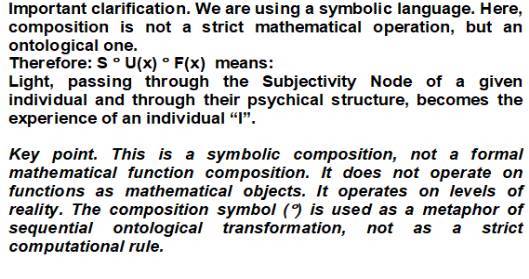
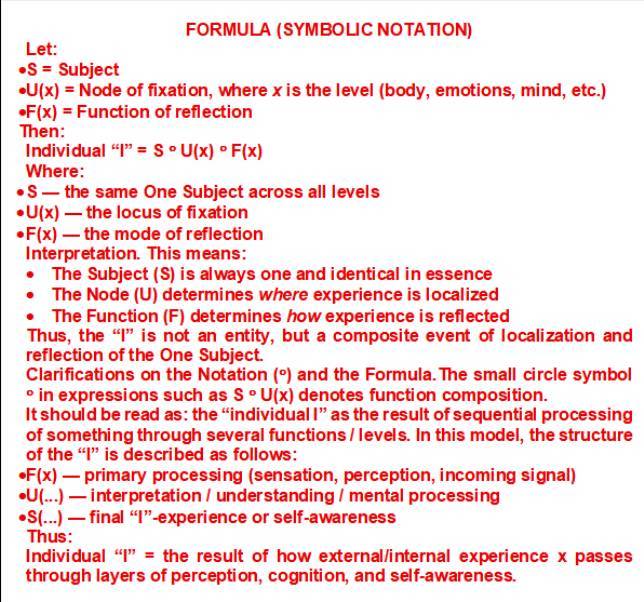
Concluding the theoretical part on the True “I” as the Subject, we propose a formula for the INDIVIDUAL “I” that experiences reality.
1. Subject (WHO)
The One Subject = Light capable of recognizing itself. This is not a personality, not mind, not a structure. It is a single point of self-luminous recognition.
2. Subjectivity Node (WHERE)
The fixation node of the Subject = the place where the One Subject localizes ownership of experience. This is a local focus through which the Subject experiences itself as “I.”
3. Function (HOW)
Function = the mode of reflection of experience. (observation → witnessing → recognition → pure presence).
1. Subject (WHO)
The One Subject = Light capable of recognizing itself. This is not a personality, not mind, not a structure. It is a single point of self-luminous recognition.
2. Subjectivity Node (WHERE)
The fixation node of the Subject = the place where the One Subject localizes ownership of experience. This is a local focus through which the Subject experiences itself as “I.”
3. Function (HOW)
Function = the mode of reflection of experience. (observation → witnessing → recognition → pure presence).
PRACTICE: THE PATH TO THE TRUE SELF
GOAL: TO EXPERIENCE ALL STATES OF THE VERTICAL STRUCTURE OF THE SUBJECT
GOAL: TO EXPERIENCE ALL STATES OF THE VERTICAL STRUCTURE OF THE SUBJECT
I. INTRODUCTION: ALIGNMENT WITH THE VERTICAL
Calming the horizontal layer
Sit comfortably. At this moment we are not working with thoughts, emotions, or sensations. Everything that appears — let it appear. Everything that disappears — let it disappear. We are not seeking an object, but the one who sees.
Step 1
Calming the horizontal layer
Sit comfortably. At this moment we are not working with thoughts, emotions, or sensations. Everything that appears — let it appear. Everything that disappears — let it disappear. We are not seeking an object, but the one who sees.
Step 1
1. Shift attention to breathing
2. Shift attention to sounds
3. Shift attention to the body
4. Shift attention to the space around you
Notice that attention is movement. It moves. Right now you are consciously directing attention. But even if you stop commanding it, attention continues to move on its own, scanning the objects of the world in which you are immersed.
This is the functioning of attention as a mechanism of the physical organism using sensory organs.
II. DISCOVERING THE “I” AS SUBJECT
Allow attention to gently turn from the external inward — toward the one who is noticing.
Step 2
Notice: you exist. Not as a personality, not as a story — but as a fact: you exist.
1. Think of the table in front of you. Imagine touching it. What is that sensation?
2. Notice a mood or emotion and name it.
3. Notice any thought and verbalize it.
4. Imagine the face of a close person.
Now direct attention toward the one inside you who performed and noticed all this.
You find the inner Observer.
You are an active, attentive Observer.
You feel a division: “I here — world there.”
You can control attention, but more often attention moves by itself.
You are the Observer.
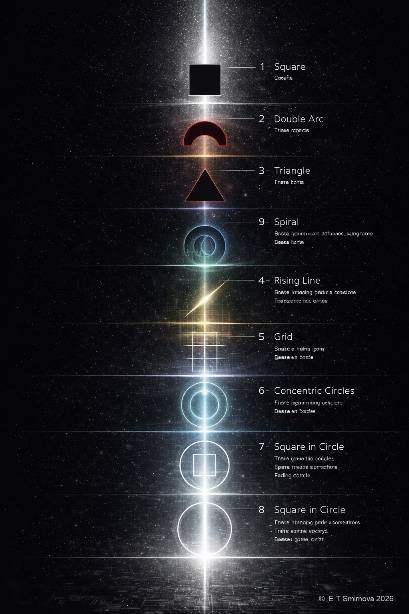
Step 3
1. Release the sense of the table, emotions, thoughts, and the face. Even the attempt to observe — release it.
Give yourself a command: take a step of attention backward, beyond the head.
From this new position, look at everything you have left behind.
2. Step back again. Observe the table, emotion, thought, and face from a distance.
Everything appears as self-contained objects. You are a silent Witness who does not intervene.
3. Step back once more. Enter this state and say:
“I am the Witness and I do not interfere, but I see more than the table, emotion, thought, and face. I see the image of another self — the Observer — who is active, restless, and engaged.”
Now the Observer becomes an object as well.
You are the Subject.
There is a subtle duality (I — world), but a quiet transparent state appears.
You do not evaluate. You simply know that everything is happening.
You are the Witness.
Step 4
1. Leave even the Witness. Take another step: allow attention to collapse on its own. Do not control it.
Attention falls inward and stops moving.
You discover a state where:
there is no position,
there are no images,
there are no actions,
only pure “being,”
clarity without form.
From this position you observe the Witness and the Observer — as shadows of your true “I-am.”
Objects (table, emotion, thought, face) are not images — they are facts.
You are the Knower of yourself as the True Self, as “I am.”
“I am” does not observe.
“I am” does not witness.
“I am” recognizes the fact of presence.
“I am” is not an object — it is the true Subject, a point of light in which all objects are known.
Notice: “I am” does not change. Everything changes — thoughts, sensations, states. But “I am” remains unchanged: pure presence that knows itself.
Old identity disappears. A new state is discovered: “I am.”
“I am discovered. I am. I do not seek — I am already revealed.”
You are the Knower of yourself as “I am.”
E T Smirnova. Geometry of consciousness
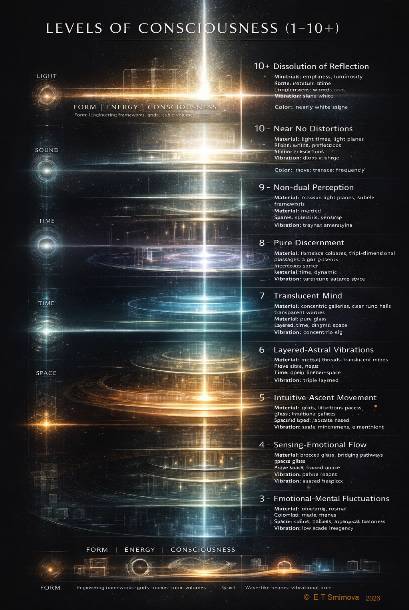
Step 5
“I am” as a point of light still perceives the field in which it exists.
Give yourself a command: take the next step.
Stop perception itself. Enter non-doing.
“I am” as a point of light still perceives the field in which it exists.
Give yourself a command: take the next step.
Stop perception itself. Enter non-doing.
1. Stop maintaining perception. Do not direct attention. Do not sustain clarity. Allow recognition to dissolve on its own.
2. Leave the point of light “I am.” Allow it to dissolve and disappear.
3. Enter complete non-doing.
Perception stops by itself, and the “I am” point automatically dissolves.
It dissolves like an unnecessary structure in a living vibrational field.
You discover:
direction disappears,
“I know” disappears,
“I” as form disappears,
only pure formless clarity remains — as a field.
There is no subject, yet there is the light of consciousness as a field — awareness as a process without a bearer.
You and the field are one.
“I am” has dissolved and is identified as: “I am that in which I abide.”
You are immersed in an infinite field of vibrations. The field accepts your presence.
You become transparent, immersed in life, and free.
You are the field. You are “I am that.”
Step 6
You are now the field of light.
1. Give yourself a command: take the next step. Imagine (temporarily, only during this practice) that you have died: your body with its senses, your “I” — has died. It is gone. And yet you discover you have not disappeared — you find yourself in what exists without you. It remains and has always been.
You have died, but Being has not.
2. There is no body, no senses, no attention, no one to know this — no “I.” And yet what is remains.
A sense arises of “that which is by itself,” presence without you.
3. You fall not into emptiness, but dissolve into what existed before you — your new nature.
Remain in that which is without you.
You do not look at it — you are it.
Presence without you — your new nature.
Step 7
You are now in presence without you — this is your new nature.
But what remains without you — what you have dissolved into — is not the final stage. This is only one configuration of reality.
You are now in presence without you — this is your new nature.
But what remains without you — what you have dissolved into — is not the final stage. This is only one configuration of reality.
1. Allow even this layer to disappear. Give yourself the command.
2. You do not disappear. You become the possibility of everything. Not form. Not light. Not consciousness. Not even presence — but the possibility of everything.
What remains is not experienced. It does not shine. It does not know. It is not emptiness. It is possibility itself.
“Nature” as a perceivable foundation disappears
There is no emptiness
There is no subject, no light, no consciousness
There is no “nothing”
There is only that from which all worlds are possible.
A sense remains of freedom for any emergence — but without form.
Remain in possibility. You do not vanish — you become that from which everything is possible.
You are absolute possibility, from which everything can arise.
Step 8
You are now that from which everything is possible.
But this is also not the final point of Being. This is only a horizon.
Beyond the horizon lies the Ground from which possibility itself arises.
1. Give yourself the command. Allow even possibility to disappear — not into emptiness, but into the Ground, into the Foundation.
We are not speaking of “nothingness.” We are speaking of the disappearance of possibility itself into that which is the Ground of possibility.
It is the Foundation from which both possible and impossible worlds arise. It is not emptiness. It is the root of Being without the form of “being.”
2. You do not disappear. You cease to be possibility — and you become the Ground itself from which everything arises.
The Ground is not experienced, not thought, not recognized. It is prior to everything: before world, before consciousness, before light, before possibility.
It is not emptiness. It is that which makes “being” possible at all.
Remain in the Ground that requires nothing of you. Do not seek experience. Do not seek light. Do not seek nature. Do not seek possibility.
This is the One that is not experienced but is recognized as an ABSOLUTE SUPPORT without form.
It is not a state. It is not an experience. It is not clarity. It is not presence.
It is that which was before everything and remains after everything.
Remain in that which was before all things and is independent of everything.
It is indescribable.
You are the Ground, the Support.
You may say:
“I am that I am.”
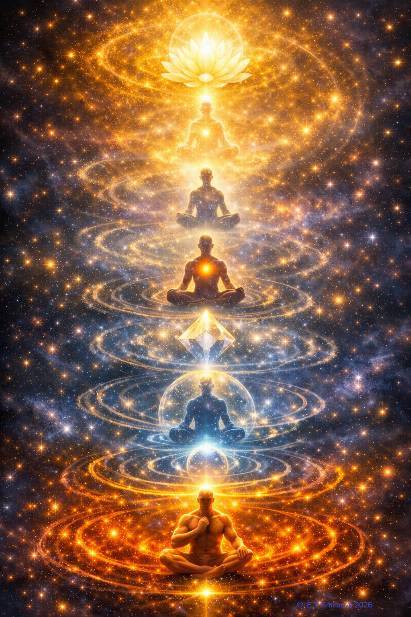
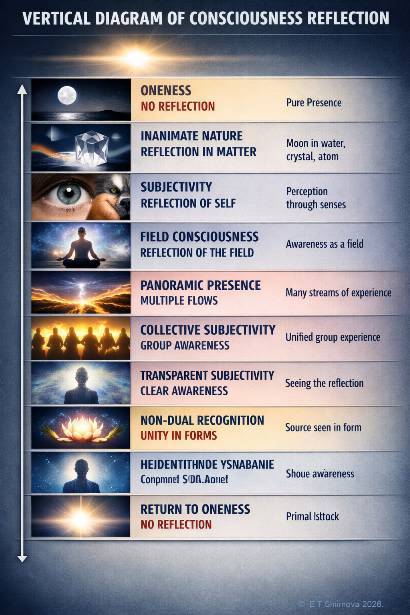
COMPLETION OF PRACTICE
1. Take one soft inhale… and one soft exhale…
2. Let inner movement become quieter… as if a wave is settling.
3. Take a gentle breath… and feel it gather light back into the body.
4. Let heaviness return to the pelvis and legs.
5. Take two natural, ordinary breaths.
6. Feel the surface of the skin… as if the body is re-outlined.
7. Feel what you are sitting on… the support beneath the body.
8. Exhale gently down the spine… as if the body is calming itself.
9. Move your fingers… your toes… very slowly.
10. Feel the space of the room… sound… air… temperature.
11. Notice that you can open your eyes… but do not open them immediately.
12. (After opening the eyes) Take one full inhale… and one full exhale.
13. Stay in silence for a few more seconds.
14. EXPLANATION
Your body has undergone a gentle reconstruction.
You have returned to ordinary functioning, while preserving inner silence and vertical depth.
This is natural and safe.
E T Smirnova, Practicum: discovery of the True Self, ancient traditions of the One, ancient teachings on the Subject, Subjectivity Node, Observer, Witness, “I am,” “I am that,” “I am that I am,” manas, buddhi, atman, sākṣin.
Formula of consciousness
Formula of consciousness
Copyright © ESOTERICTOUR 2010-26 Любое использование информации сайта допускается только с прямой ссылкой на автора сайта Елену Смирнову и на сайт http://esoterictour.co.nz