






Who is
the World Teacher ?He - One, but He has many names:
the World Teacher ?He - One, but He has many names:
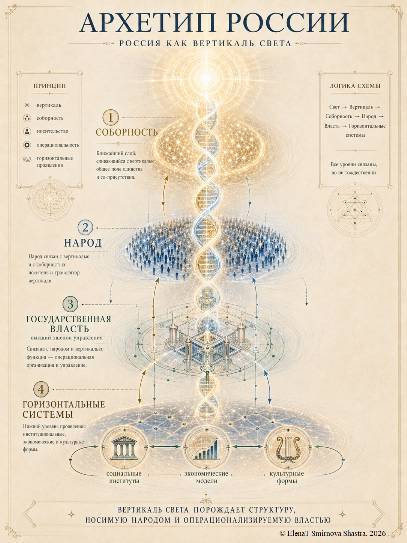
Fig1. © ElenaT Smirnova Shastra. 2026
The archetype of Russia as a vertical of ligh.
The diagrams preserve their original Russian labels, as they are part of the author’s primary research materials and reflect the structure of the original analytica model.
The diagrams preserve their original Russian labels, as they are part of the author’s primary research materials and reflect the structure of the original analytica model.
This project presents a structural and phenomenological analysis of the ethnonym Russia using a metadisciplinary method that combines linguistics, cultural ontology, and systems thinking. The focus is on how linguistic forms encode organizational patterns that can be interpreted within a broader conceptual framework. The approach is analytical rather than political: it examines structural dynamics that may appear in any cultural or linguistic system.
The method used in this study — Transdisciplinary Phenomenology of EthnoArchetypes and Metalinguistic Structures — explores how cultural meaning emerges from linguistic morphology, geometric patterns, and phenomenological dynamics. It treats ethnonyms as structural objects whose internal organization can be reconstructed and compared across languages.
In this context, Russia serves as a case study illustrating how different alphabetic systems preserve or transform underlying structural invariants. The analysis does not aim to describe national identity or geopolitical narratives. Instead, it demonstrates how linguistic forms can reveal stable patterns of organization that are relevant for cultural studies, semiotics, and interdisciplinary research.
This framework is intended for readers interested in conceptual models of culture, crossalphabet analysis, and the phenomenology of meaning.
The method used in this study — Transdisciplinary Phenomenology of EthnoArchetypes and Metalinguistic Structures — explores how cultural meaning emerges from linguistic morphology, geometric patterns, and phenomenological dynamics. It treats ethnonyms as structural objects whose internal organization can be reconstructed and compared across languages.
In this context, Russia serves as a case study illustrating how different alphabetic systems preserve or transform underlying structural invariants. The analysis does not aim to describe national identity or geopolitical narratives. Instead, it demonstrates how linguistic forms can reveal stable patterns of organization that are relevant for cultural studies, semiotics, and interdisciplinary research.
This framework is intended for readers interested in conceptual models of culture, crossalphabet analysis, and the phenomenology of meaning.
Excerpt from ElenaT Smirnova ’s forthcoming book.
The monograph explores the concept of the Archetype of Russia, reconstructed through the author’s scientific method of Transdisciplinary Phenomenology of EthnoArchetypes and Metalinguistic Structures. This approach integrates depth psychology, ethnolinguistics, and the ontology of culture into a unified analytical framework.
As a new metadiscipline, it enables the use of multiple linguistic systems in research — Sanskrit, Russian, English, and the most ancient protolanguage, Senzar.
Through the study of the ethnonymtoponym “Russia,” the work identifies its archetypal structure, mission, dynamic patterns, and the geometric form of Russia as a culturalontological entity.
Special attention is given to the interaction between the Archetype of Russia and the archetypal structures of other nations and cultures that shape the system of global ontological relations. To support this analysis, the monograph additionally examines the ethnonyms of eleven countries that significantly influence planetary dynamics, as well as the crossalphabet matrix through which speakers of different languages perceive the ethnonym “Russia.”
SECTION IV. THE SEMANTIC MODEL OF THE ARCHETYPE “RUSSIA”: NATURE, ORIGIN, STRUCTURAL DESTINY (abridged)
In the context of this article, “meaning” refers to a structural characteristic of organization that reflects the degree of coherence, directionality, intensity, generative capacity, and integrative function of a system’s elements. It captures the structure’s ability to generate transitions between phases, maintain internal connectedness, and form new levels of order. In this model, meaning is not a metaphysical or religious concept; it describes the phenomenological dynamics of complex systems.
1. The Semantic Core of the Archetype of the Ethnotoponym “Russia” (root structure)
The core is derived from the analysis of three layers: the phoneticmorphemic level, the Sanskrit projection, and the phenomenological level. This yields the formula: ROS + SIYA = growth + manifestation of light (archetype: “the growing light becoming revealed”).
Light, in the context of this article, is a universal operation of manifestation — a universal function of transition between different phases of a structure. Its meaning is to make the invisible visible. Radiance functions as the act of illuminating inner content, that is, the transition from the unmanifested to the manifested.
2. Geometric formats
Geometric formats are derived from the morphological analysis of the word Russia. The reconstruction reveals a vertical function: beginning → maximum → completion. These points reflect the lower horizontal states of variable flows and the vertical maximum toward which they strive.
3. The model of potentiality
The model of potentiality follows from geometry. All methods indicate a single maximum — a local center of density, an “energetic mountain.” A maximum is a mathematical concept indicating that the model contains a point of highest concentration, revealing the potential peak of the structure. Fig 2.
4. Two flows
Two flows — A (accumulation, involution) and B (manifestation, evolution) — lead toward the point of potential maximum.
5. The hidden program of the Archetype of Russia
A hidden program has been identified: a latent potential that grows for a long time and then manifests. This type of dynamic is a wellknown phenomenon in ontology and is thoroughly described in scientific literature. Disciplines that study such paired dynamics include: systems dynamics, nonlinear phenomenology, phase transition theory, and synergetics.
6. Vertical dynamics
The vertical dynamics of the Archetype of Russia appear in its ability to connect the two horizontal phases A and B. This is an archetypal process of linking, achieved through the movement of meanings and light across all horizontal levels. (see Fig. 1)
7. Phenomenological profile
The phenomenological profile of the Archetype of Russia has the following symbolic framework: heavy foundation (lower knot) → double spiral → upper rupture → emergence into light.
8. Structural geometric model
The structural geometric model of the Archetype of Russia takes the form of a triangle. In geometric terms, the triangle is the first minimal figure that creates a closed area and possesses stability. It is a universal figure through which any system can be described. It symbolizes ascent because the third element does not merely add to the first two — it creates a new space of meaning.
The semantic core of the triangle’s geometry in the Archetype of Russia is the form in which unity becomes multiplicity, and multiplicity returns to unity. It symbolizes manifestation, balance, and the connection between higher and lower. It represents the transition from possibility to actuality. To fulfill this semantic function, the triangle must be closed and structurally stable.
9. The meaning of the spiral in the geometry of the word “Russia”
The spiral expresses two phases that continuously transition into one another — the two flows A and B, connected by the potential apex of the triangle. Between them lies a double ascending line and spiral retention, that is, a process of synthesis. These are two opposing dynamics of consciousness that Russia holds as a unified cycle. (see Fig. 2)
10. Subjectivity of the Archetype of Russia
The subjectivity of the Archetype of Russia is an archetypal structure that manifests as a subject of transition. Geometrically, the upward movement through levels has its own structure, and the Archetype of Russia as a geometric object has the following form:
Vertical axis (ideal program) → Lower level — accumulation (double foundation) → Second level — double spiral → Middle level — central knot (the moment of transition) → Circle of wholeness (sobornost) → Unfolding maximum above → Upper knot — radiation and three spheres (distinction, linking, reflection) → Highest level — radiance, manifestation of light.
11. Sobornost
Sobornost, as the “connecting” component of the Archetype of Russia, forms the axis of verticality and the morphological structure of the ethnotoponym Russia. It follows from its archetypal core, from the dynamics of levels, and from the function of the ethnotoponym as a carrier of collective subjectivity — a property embedded in the structure of the word Russia itself.
12. Cyclical time
The Archetype of Russia possesses its own archetypal cyclical time: prolonged pressure → sudden manifestation → restoration → new cycle. Long periods of silence followed by sudden flashes are the result of cyclical pressure generated by the archetype’s internal meanings.
The spiral expresses two phases that continuously transition into one another — the two flows A and B, connected by the potential apex of the triangle. Between them lies a double ascending line and spiral retention, that is, a process of synthesis. These are two opposing dynamics of consciousness that Russia holds as a unified cycle. (see Fig. 2)
10. Subjectivity of the Archetype of Russia
The subjectivity of the Archetype of Russia is an archetypal structure that manifests as a subject of transition. Geometrically, the upward movement through levels has its own structure, and the Archetype of Russia as a geometric object has the following form:
Vertical axis (ideal program) → Lower level — accumulation (double foundation) → Second level — double spiral → Middle level — central knot (the moment of transition) → Circle of wholeness (sobornost) → Unfolding maximum above → Upper knot — radiation and three spheres (distinction, linking, reflection) → Highest level — radiance, manifestation of light.
11. Sobornost
Sobornost, as the “connecting” component of the Archetype of Russia, forms the axis of verticality and the morphological structure of the ethnotoponym Russia. It follows from its archetypal core, from the dynamics of levels, and from the function of the ethnotoponym as a carrier of collective subjectivity — a property embedded in the structure of the word Russia itself.
12. Cyclical time
The Archetype of Russia possesses its own archetypal cyclical time: prolonged pressure → sudden manifestation → restoration → new cycle. Long periods of silence followed by sudden flashes are the result of cyclical pressure generated by the archetype’s internal meanings.
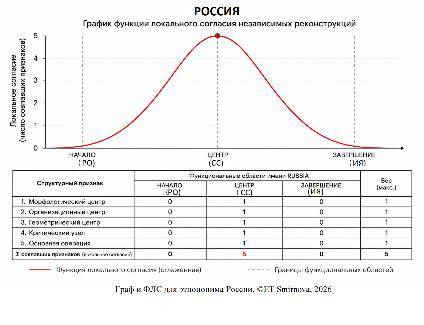
Fig 2.© ElenaT Smirnova Shastra. 2026
Graph of LocalAgreement Functions in Independent Reconstructions of the Ethnotoponym “Russia.”
13. Functional formats
The functional formats of the Archetype of Russia represent a type of movement with its own dynamics. Russia moves upward (idealism), toward the center (sobornost), and outward (expansion).
14. Space
The space of the Archetype of Russia is a vertical vessel: a container for accumulation and a channel for manifestation.
15. Energy
The energy of the Archetype of Russia is synthesizing, formgiving, and idealistic. It accumulates slowly, is retained spirally, manifests abruptly, and always carries a luminous rather than destructive character. The energetic matrix of the word includes: Ascending energy: idealism, aspiration; Descending energy: structural formation; Centripetal energy: sobornost; Centrifugal energy: expansion.
The functional formats of the Archetype of Russia represent a type of movement with its own dynamics. Russia moves upward (idealism), toward the center (sobornost), and outward (expansion).
14. Space
The space of the Archetype of Russia is a vertical vessel: a container for accumulation and a channel for manifestation.
15. Energy
The energy of the Archetype of Russia is synthesizing, formgiving, and idealistic. It accumulates slowly, is retained spirally, manifests abruptly, and always carries a luminous rather than destructive character. The energetic matrix of the word includes: Ascending energy: idealism, aspiration; Descending energy: structural formation; Centripetal energy: sobornost; Centrifugal energy: expansion.
Analysis shows that the Archetype is the underlying cause of all dynamic forces
The Archetype, understood as meaning, is a form, a law of organization, a potential structure that exists prior to any social manifestations.
Based on the full morphological analysis, we identified the semantic fields of the Archetype “Russia,” which may be interpreted as its tasks, goals, and mission.
1. Russia = an archetype of integration through the transformation of form.
2. Sobornost = the central axis of the ethnotoponym, connecting land, people, history, and the vertical axis of meaning.
3. The meaning of the Archetype “Russia” is synthesis through form and ideal.
4. The marker of meaning in the Archetype of Russia is a vertically standing point of light that enables the transition between two horizontal phases.
5. The manifestation of the Archetype’s meaning occurs through vertical synthesis rather than horizontal opposition.
6. Morphological mission: to bring light into the transition between accumulation and manifestation.
7. The heart of the Archetype’s meaning is a force that creates a field of unification among diverse forms while maintaining an axis of centralization.
8. As a type of connection, the Archetype activates:
The Archetype, understood as meaning, is a form, a law of organization, a potential structure that exists prior to any social manifestations.
Based on the full morphological analysis, we identified the semantic fields of the Archetype “Russia,” which may be interpreted as its tasks, goals, and mission.
1. Russia = an archetype of integration through the transformation of form.
2. Sobornost = the central axis of the ethnotoponym, connecting land, people, history, and the vertical axis of meaning.
3. The meaning of the Archetype “Russia” is synthesis through form and ideal.
4. The marker of meaning in the Archetype of Russia is a vertically standing point of light that enables the transition between two horizontal phases.
5. The manifestation of the Archetype’s meaning occurs through vertical synthesis rather than horizontal opposition.
6. Morphological mission: to bring light into the transition between accumulation and manifestation.
7. The heart of the Archetype’s meaning is a force that creates a field of unification among diverse forms while maintaining an axis of centralization.
8. As a type of connection, the Archetype activates:
Linking (sobornost),
Context (multinationality),
Reflection of light (idealism),
Choice (transitional states).
9. The semantic motto of the Archetype of Russia: “By uniting — to transform.”
SECTION V. THE ROOT STRUCTURE OF THE ETHNOTOPONYM “RUSSIA” AND THE INTERPRETATION OF MEANINGS IN CROSSALPHABET RECONSTRUCTION
The analysis of the word Russia in its Russian, English, and Sanskrit forms, conducted using the FLS method, revealed the following:
Archetypal Interpretation of the Word “Russia”
It was found that the object of study is not the word itself, but the nominal form of the object. In other words, Россия, Russia, and रूसिया are not translations of one another. They are three distinct realizations of the same nominal entity. Our task was to determine to what extent these forms preserve the same organizational invariant.
In this reconstruction, the roots ROS and SIYA are interpreted not as meanings but as operations. Light, within this model, is a phenomenological function of manifestation embedded in the morphology of the word. (See Figures 3 and 4)
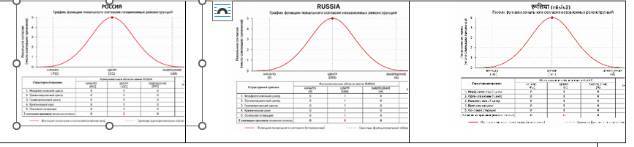
Fig 3. © ElenaT Smirnova Shastra. 2026
Graph of LocalAgreement Functions in Independent Reconstructions of the Ethnotoponym “Russia” across Three Languages — Russian, English, and Sanskrit.
Graph of LocalAgreement Functions in Independent Reconstructions of the Ethnotoponym “Russia” across Three Languages — Russian, English, and Sanskrit.
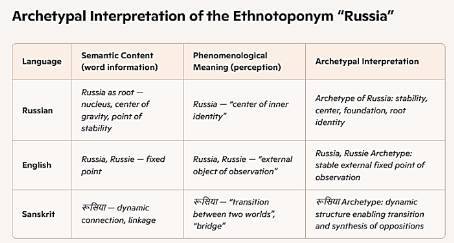
Fig 4 © ElenaT Smirnova Shastra. 2026Archetypal Interpretation of the Ethnotoponym “Russia”
Findings
1. The crossalphabet form of the Archetype “Russia” preserves the structural law across all three languages. The coincidence of features is not merely phonetic; it is a structural correlation across analytical levels.
2. The motif of light, as the function of manifestation within the Archetype “Russia,” remains stable in all three languages, because it arises from the dynamics of transition rather than from etymology.
3. In all three languages, the Archetype “Russia” appears as a vertical structure that transforms accumulation into manifestation — that is, into a lightproducing operation.
4. Structure and geometry remain consistent, while semantic content shows only partial overlap. Depending on the language in which the word is spoken (read, thought), the Archetype of Russia exerts different archetypal effects.
The analysis demonstrates that the three linguistic systems refer to the same object — Russia — but through different archetypal centers.
RUSSIAN — “RUSSIA AS ROOT”
Center of coincidence: morphological core
Archetype: root, foundation, inner point of identity
Phenomenology: Russia is perceived as a center of gravity, an internal nucleus of structure
ENGLISH — “RUSSIA AS FIXED POINT”
Center of coincidence: phonetic node sh
Archetype: object of observation, stable external point
Phenomenology: Russia appears as an external object fixed by the observer
SANSKRIT — “रूसिया AS BRIDGE”
Center of coincidence: transition si
Archetype: bridge, linkage, transition between two states
Phenomenology: Russia is perceived as a dynamic connection — not a core and not an object, but a transitional structure
Keywords: Archetype of Russia; differences in the perception of Russia’s archetype by other countries; mission of Russia; structure of the Archetype of Russia; dynamics of the Archetype of Russia; crossalphabet reconstruction of the ethnotoponym Russia.
End of sample fragment
About the author
ElenaT Smirnova Shastra
- PhD psychologist.
- The author of over 50 scientific publications in psychology and 19 monographs.
- Member of The Institute of Planetary Synthesis (IPS) at the UN, (Мember of the Board of Advisors IPS).
- Member of The Society for Existential Analysis (United Kingdom):
- Member of The Russian League of professional psychotherapists (PPL) National Awarding Organisation (NAO) for the European Certificate of Psychotherapy.
- Member of the International Federation of Journalists (IFJ) and the Russian Union of Journalists.
- Member of The Noosphere Spiritual Ecological World Assambly.
Lives and works in New Zealand.
Signed the Manifesto for a Post-Materialist Science
Вебсайт http://esoterictour.co.nz/

Copyright © ESOTERICTOUR 2010-26 Любое использование информации сайта допускается только с прямой ссылкой на автора сайта Елену Смирнову и на сайт http://esoterictour.co.nz